Making Your Sites Tablet and Mobile Friendly With Elementor

Joomla Beginner Class, Lesson #1: Introduction to Joomla

Joomla vs. WordPress: Choosing the Right CMS for Your Site

Moe Long 02-10-2018 5 minutes


Joomla vs. WordPress: Choosing the Right CMS for Your Site

There’s no shortage of content management system (CMS) options on the market. Consistently, WordPress ranks among the most popular CMSes. While WordPress is easily one of the top choices, the likes of Drupal and Joomla provide viable alternatives. Learn more about WordPress vs. Joomla, and find the right CMS for your site!

What Types of Website Can You Make?

Among the most critical elements in choosing a content management system is site type. WordPress is ideal for everyone from beginners to seasoned pros. My first ever website was a free WordPress.com site, and it’s an awesome platform to begin blogging quickly.

With managed hosting, I was able to spin up a blog in a matter of minutes therefore concentrating on content creation. As such, WordPress functions for basic blogging, professional websites, business use, and e-commerce. Since you can easily transfer a free WordPress.com site to a self-hosted installation, it’s highly scalable and flexible.

The Best Web Hosting ServicesThe Best Web Hosting ServicesLooking for the best web hosting service for your needs? Whether it's for a small blog or a major corporate website, here are our best recommendations.READ MORE

Likewise, Joomla is versatile. While it’s capable of running a basic website, it’s more complex than WordPress and not quite as simple to set up. Therefore, it’s not recommended for beginners. Instead, Joomla works better for business purposes, e-commerce, and notably community forums and social networking.

Best WordPress site types:

Blogging


Websites


Business/professional sites


E-commerce


Social networking


Best Joomla site types:

Business/professional sites


E-commerce


Social networking/community forums


Which CMS Is Most Popular?

Image Credit: W3techs

Unfortunately, with content management systems, popularity does matter. Whereas unpopularity in school days merely meant eating your pizza Lunchables alone, a widely used CMS translates to increased community resources like plugins and forums.

WordPress clocks in the highest market share at 60 percent according to W3techs, with Joomla in second at 5.8 percent. That’s a massive disparity between the two. Based on that alone, it’s worth considering WordPress over Joomla. Since WordPress features a larger userbase, it therefore benefits from many more community-made resources like plugins, tutorials, and custom themes.

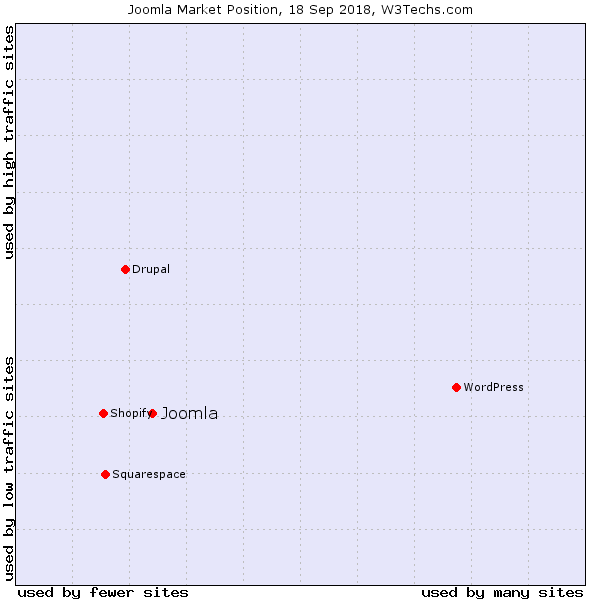
Furthermore, Joomla falls into an odd space where it’s used by fewer and lesser-trafficked sites. Compare that to Drupal which is used by fewer, but more trafficked, sites. Then WordPress is used by a high number of websites which vary in site traffic. Though it’s the second most used CMS, Joomla lags behind both WordPress and Drupal in site use and traffic. As such, it’s less popular.

Winner: WordPress

Search Engine Optimization (SEO)

While Joomla is fine for search engine optimization (SEO), WordPress dominates. By default, Joomla includes a meta description and meta keywords feature. However, the ultra-popular Yoast plugin for WordPress provides greater functionality.

Yoast’s SEO plugin offers simple to understand red, yellow, and green color systems for poor, okay, and good SEO. Moreover, its readability section offers insight into readability best practices, such as using transition words and minimizing passive voice.

For its search engine optimization portion, Yoast lets you input keywords and likewise gives specific feedback for improving SEO. Joomla does include SEO plugins including Easy Frontend SEO and SEO Generator, but Yoast beats these options.

Winner: WordPress

Security and Updates

Both Joomla and WordPress see frequent security patches. WordPress, though sporting a beefy security team, is decidedly more popular and widely used than Joomla. As such, it’s more prone to cyber attacks. Thankfully, its massive amount of plugins means there’s a way to combat cybercrime. Nevertheless, Joomla’s small security team is offset by its lower popularity which translates to less frequent attacks.

Winner: Joomla

Costs and Pricing

The cost of using WordPress vs. Joomla varies quite a bit. Both CMSes offer free hosting as well as paid self-hosted options. From Bluehost to Hostgator, there are many WordPress hosting providers, many offering one-click-installs. A paid option can set you back anywhere from a few dollars a month to hundreds depending on your needs. Essentially, the cost is pretty comparable.

Winner: Tie

Community and Support

With its bevy of resources, WordPress handily trounces not only Joomla, but virtually every competing CMS. Boasting more than 40,000 plugins and thousands of themes, WordPress features a thriving community with resources such as our ultimate WordPress guide. For instance, when creating my personal website, I sought a theme with a review schema. Options abounded, and I selected my favorite.

The Best WordPress PluginsThe Best WordPress PluginsREAD MORE

With a over 1,000 themes and several thousand plugins, Joomla offers its own resources. Additionally, you’ll find resources on many sites like our beginner’s guide to Joomla.  However, Joomla lags behind WordPress.

Winner: WordPress

Setup and Ease of Use

There’s a reason so many websites are WordPress-based. It’s one of the most beginner-friendly CMSes. Largely, this derives from its massive market share.

According to WebsiteSetup, WordPress holds a whopping 59.9 percent of all CMS market share. Joomla clocks in at second place with 6.6 percent. Since there’s self-hosted and third-party hosting in WordPress.com and WordPress.org, options range from self-installation to a WordPress that’s ready to use out-of-the-box.

Similarly, Joomla may be downloaded and installed or run for free from Joomla.org. Using both, I found WordPress a bit more intuitive although that largely derives from familiarity.

Despite its simple set up and configuration, Joomla is more complicated than WordPress. It’s not as complex as Drupal, though still less intuitive. While you can create a basic site with Joomla in a matter of minutes, moderate to advanced tweaks aren’t as easy. WordPress can be as easy or complicated as you make it, and thus edges ahead of Joomla.

Winner: WordPress

Who Uses Joomla vs. WordPress?

Among the more renowned sites using Joomla, you’ll find Linux.com, Harvard University, and Nintendo Nordic. As WPBeginner reveals, heavyweights such as TechCrunch, BBC America, and The New Yorker operate on WordPress. Clearly, as a blogging platform and professional content website, WordPress wins.

Winner: WordPress

WordPress vs. Joomla: Which Should You Use?

Overall, both Joomla and WordPress provide tons of functionality, flexibility, and resources. Joomla isn’t a poor CMS choice per se, but it’s far less used than WordPress. The same can be said of any competing content management system including Drupal.

However, with its balance of intuitiveness, versatility, and popularity, WordPress is easily the top choice as a CMS. Unless you’re spinning up an e-commerce site or forum, WordPress is arguably the best CMS. Truthfully, unless you’re already well-ingrained in the Joomla ecosystem, it’s better just to stick with WordPress.

Joomla 3.8.8 is now available

joomla 3.8.8
Joomla 3.8.8 is now available. This is a security release which addresses 9 security vulnerabilities, contains over 50 bug fixes, and includes various security related improvements.

What's in 3.8.8?

Joomla 3.8.8 addresses 9 security vulnerabilities  / hardenings and several bugs, including:

Security Issues Fixed

  • Low Priority  - Core - ACL violation in access levels (affecting Joomla 2.5.0 through 3.8.7) More information »
  • Low Priority -  Core - Add phar files to the upload blacklist (affecting Joomla 2.5.0 through 3.8.7) More information »
  • Moderate Priority -  Core - Information Disclosure about unpublished tags (affecting Joomla 3.1.0 through 3.8.7) More information »
  • Low Priority -  Core - Installer leaks plain text password to local user (affecting Joomla 3.0.0 through 3.8.7) More information »
  • Moderate Priority -  Core - XSS Vulnerabilities & additional hardening (affecting Joomla 3.0.0 through 3.8.7) More information »
  • Low Priority - Core - Filter field in com_fields allows remote code execution (affecting Joomla 3.7.0 through 3.8.7) More information »
  • Low Priority - Core - Session deletion race condition (affecting Joomla 3.0.0 through 3.8.7)  More information »
  • Low Priority - Core - Possible XSS attack in the redirect method (affecting Joomla 3.2.1 through 3.8.7)  More information »
  • Low Priority - Core - XSS vulnerability in the media manager (affecting Joomla 1.5.0 through 3.8.7)  More information »
Please see the documentation wiki for the security recommendations for updated sites.
More details about the session deletion race condition are available on the Developer Network site.

Bug fixes and Improvements

  • Miscellaneous accessibility improvements for the Backend
  • Updated CodeMirror to 5.37 and various improvements #20269 #19833 #12542
  • Improved handling of numeric user group names #20091
  • [com_content] Filter by no author #20245
  • Added support for PHP 7.3’s is_countable function #20441
  • Sending passwords by email disabled by default for new installs #20247
Visit GitHub for the full list of bug fixes.

MALICIOUS PHP SCRIPT INFECTS 2,400 WEBSITES IN THE PAST WEEK

A botnet dubbed Brain Food is giving webmasters indigestion with related attacks that push bogus diet pills and IQ-boosting pills via web pages hosted on legitimate sites. So far, spammers have been successful, thanks to an effective Hypertext Preprocessor (PHP) script (also called Brain Food) that has adroitly avoided detection on websites hosting the pitches.
Over the past four months, researchers at Proofpoint said they have tracked 5,000 Brain Food compromised websites. In a post outlining its research Friday, Proofpoint said 2,400 of those compromised sites have been active over the past seven days pushing dubious pills under the false premise the product claims made were originally on television shows Shark Tank and on identified as Entertainment Today.
“While this botnet is small compared to other spam sending infrastructure, the size of this botnet is sufficient to provide the operators with easily reconfigured redirects,” wrote Kevin Epstein, VP Threat Operations, at Proofpoint in an email interview with Threatpost.
Domain registrar and hosting firm GoDaddy has been disproportionately impacted by the Brain Food script, accounting for 40 percent of the 5,000 compromised sites. That’s followed by hosting firms DreamHost, UnitedLayer and CyrusOne.
“An individual website may contain multiple copies of the PHP script. We have observed this script installed on websites using different content management systems including WordPress and Joomla,” researchers wrote.
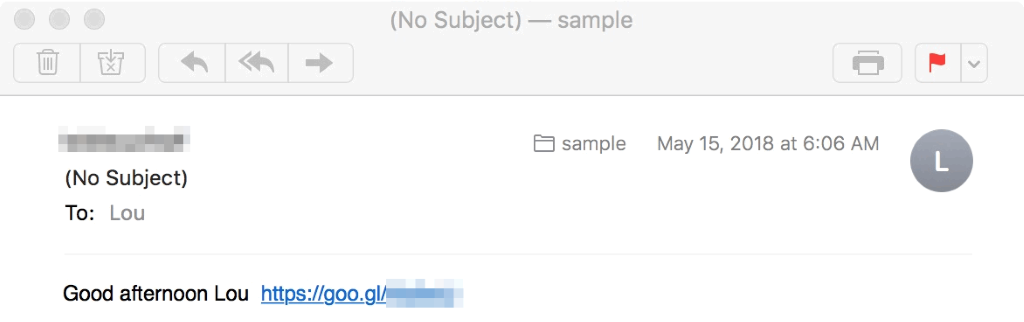
Spam attacks hit inboxes in the form of stripped down email messages typically with no subject and basic greeting (see below).
The body of the message contained a URL shortener link using Google’s goog.gl and bit.ly. Spammers had been blocked by Google’s URL shortener service when Google stopped allowing anonymous users from creating goo.gl links. “By the end of April, the spammer appears to have found a means of  circumventing the Google restrictions,” wrote researchers.
Recipients who click on the link are redirected to the compromised website that hosts the diet or intelligence-boosting pill pitch.
Brain Food: Malicious PHP Script
The script itself employs several layers of defense to evade detection by researchers and search engine crawlers. “The code is polymorphic and obfuscated with multiple layers of base64 encoding,” they said. “A version recently uploaded to a malware repository was not flagged by any antivirus engine.”
When a site is infected with the malicious Brain Food PHP code and crawled, the script redirects to the correct page. Next, it staggers for five seconds and “redirects to the root of the compromised domain, delays and returns nothing, or redirects to the UNICEF website,” researchers said.
“The attackers want victims to get redirected. But it wants search engines, analysts and sandboxes to get redirected to an innocuous site – whether it be the root of the compromised domain or the UNICEF website. The built-in delays are enough for many automated analysis systems to time out without detecting a potentially malicious redirect,” Epstein said.
Criminals maintain control over the landing pages and keep stats on the campaigns from C2 servers prostodomen1[.]com and thptlienson[.]com.

Even more worrisome, is a backdoor in the Brain Food code that allows “remote execution of shell code on web servers which are configured to allow the PHP ‘system’ command,” researchers wrote.

Attacks on Popular CMS Joomla Undetectable by Visitors

Avast, a cybersecurity company,y has warned both Joomla users of a new type of attack, which injects fake jQuery script into the header of the website. This type of script changes one line of code to allow the hacked website to point to a malicious script.


Avast stated that the amount of websites hacked using this method is “abnormally high” and has resulted in about 4.5 million users attacked. Visitors of the websites will not notice the code, unless they are looking at the source code because the script is put before the closing tag.


Attacks on Popular CMS Joomla and WordPress Undetectable by Visitors 

Details on the Privilege Escalation Vulnerability in Joomla

Details on the Privilege Escalation Vulnerability in Joomla:


"Yesterday, Joomla! 3.6.4 was released, patching a critical privilege escalation and arbitrary account creation vulnerability.

As we’ve seen some exploits attempts occurring in the wild, we feel it is a good time to describe what the issue is and how it was fixed.

"


Analyzing the Patch

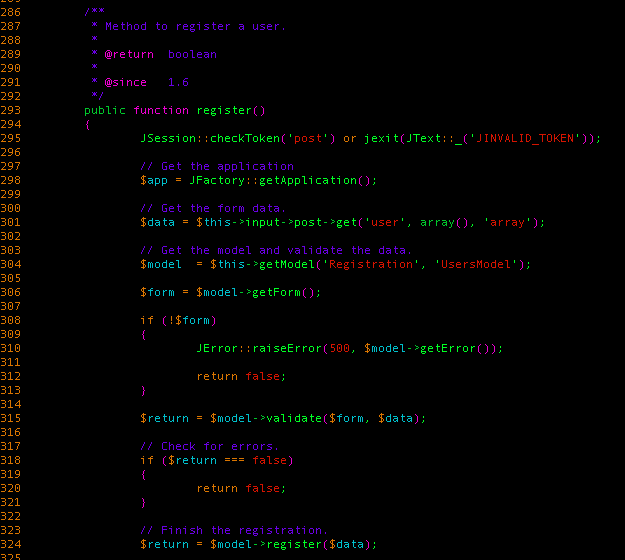
It was fairly easy to figure out where the vulnerable code was, as pretty much all the patch does (with the exception of fixing an additional two factor authentication bug) is basically remove the register method from the UsersControllerUser class. So that’s where our investigation started.


Joomla register method removed in privilege escalation vulnerability code snippet
We removed some original code for improved readability


All in all, what this method does is it takes user input from the user POST parameter (which is intended to be an associative array) and validates whether specific parameters are properly formatted (email address, username, etc.). If it’s all good, it pushes the array to the register method from the UsersModelRegistration class.


'via Blog this'

Joomla! 3.6.4 Released

Upgrade to Joomla! 3.6.4 Today


The Joomla! development team announced the immediate availability of Joomla! 3.6.4 yesterday. This update was issued to fix two critical security flaws in all versions of Joomla! from 3.4.4 to 3.6.3. 


Please note, these security vulnerabilities could lead to your site becoming compromised. So, we advise you to update to the latest version of Joomla! today.

Joomla! 3.6.4 is now available. This is a security release for the 3.x series of Joomla! which addresses two critical security vulnerabilities and a bug fix for two-factor authentication. We strongly recommend that you update your sites immediately.
This release only contains the security fixes and bug fix; no other changes have been made compared to the Joomla! 3.6.3 release.
Joomla Security Release

What's in 3.6.4

Version 3.6.4 is released to address two critical security issues and a bug regarding two-factor authentication.

Security Issues Fixed

  • High Priority - Core - Account Creation (affecting Joomla! 3.4.4 through 3.6.3) More information »
  • High Priority - Core - Elevated Privileges (affecting Joomla! 3.4.4 through 3.6.3) More information »


Joomla! 3.6.4 Released


'via Blog this'

Joomla! CMS 3.6 Beta 2 now out

The Joomla! Project is pleased to announce the availability of Joomla! CMS 3.6 Beta 2. Community members are asked to download and install the package in order to provide quality assurance for the forthcoming 3.6 release.

Joomla! 3 is the latest major release of the Joomla! CMS, with 3.6 the seventh standard-term support release in this series. Please note that going from 3.5 to 3.6 is a one-click upgrade and is NOT a migration. The same is true is for any subsequent versions in the 3 series of the CMS.

That being said, please do not upgrade any of your production sites to the beta version as beta is ONLY intended for testing and there is no upgrade path from Beta.

Release News

Joomla! 3.5.1 Released

This week saw the release of Joomla! 3.5.1 to fix a few bugs that have been reported in the latest version of the popular CMS.


Although you may not feel it is critical to keep your site updated to the latest version of Joomla!, we see new sites every day finding themselves compromised.


Are you avoiding updating your website because of the fear you may have that something may go haywire?

Joomla! 3.5.1 - Bug Release Available

Allow us to take on the frustration and let you feel at ease and continue to do what you do best with your company. We will take the hassle out of your Joomla! update!


We offer installation, maintenance and core support for the following software products


  •     Joomla!
  •     WordPress
  •     Drupal
  •     Magento eCommerce
  •     paGO Commerce


Joomla! 3.5.1 Released

Joomla! Launches Newest CMS, Joomla 3.3

Enhanced Security, Searchability and Speed Makes Joomla 3.3 Out-of-the-Box Experience More Efficient for Developers and Users


 Joomla, one of the world's most popular open source content management systems (CMS) used for everything from websites to blogs to custom apps to Intranets, today announced the immediate availability of Joomla 3.3. The newest Joomla CMS overhauls its approach to security, enables microdata for the first time and replaces MooTools-based JavaScript with jQuery equivalents. These new features make Joomla 3.3 the most secure, searchable and fastest-loading Joomla CMS yet, ensuring the most efficient developer experience for Joomla out of the box.
"Joomla has experienced unprecedented growth recently, blowing through 50 million downloads at the end of February to more than 52 million today," said Sarah Watz, newly elected president of Open Source Matters -- a nonprofit that provides organizational, legal and financial support to the Joomla project. "Despite this massive surge, we are continuing to make improvements to ensure Joomla is cutting-edge for our user community of millions of people around the globe."
More details about the key features in Joomla 3.3 include:
  • Minimum PHP version is 5.3.10 -- This substantially enhances the level of cryptography that can be used for securing passwords.
  • jQuery JavaScript -- By moving from MooTools to jQuery JavaScript, the size of Joomla websites will be reduced, ultimately enabling sites to load faster.
  • Microdata implementation -- This allows many aspects of the content rendered by the Joomla CMS to be explained to search engines using semantic information. Ultimately, this enables Joomla websites to be more searchable.
"Some of the enhancements in Joomla 3.3 came from Joomla student developers from last summer's Google Summer of Code, and we expect more cutting-edge developments from those contributors in upcoming releases," said Chad Windnagle, Google Summer of Code Co-Admin for Joomla. "Although the Joomla community has come up with amazing enhancements, it is important that we stay as current as possible by tapping contributions from the next generation of Internet pioneers like the Google Summer of Code students."
To demo Joomla 3.3 go to demo.joomla.org, to download it go to joomla.org/download, and to access a list of new features go here.


Joomla! Launches Newest CMS, Joomla 3.3

'via Blog this'


Simple Hack Threatens Joomla Sites - update NOW

If you run a site powered by the Joomla content management system and haven’t yet applied a critical update for this software released less than two weeks ago, please take a moment to do that: A trivial exploit could let users inject malicious content into your site, turning it into a phishing or malware trap for visitors.
joomlaThe patch released on July 31, 2013 applies to Joomla2.5.13 and earlier 2.5.x versions, as well as Joomla3.1.4 and earlier 3.x versions. Joomla credits discovery of the bug to Web security firm Versafe, which says a simple exploit targeting the vulnerability is already in use. Joomla versions 2.5.14 and 3.1.5. fix a serious bug that allows unprivileged users to upload arbitrary .PHP files just by adding a “.” (period) to the end of PHP filenames.
For 2.5.x and 3.x versions of Joomla, it is possible for anyone with access to the media manager to upload and execute arbitrary code simply by appending a period to the end of the file name they would like to run. For sites powered by unsupported versions of Joomla (1.5.x, and a cursory Google search indicates that there are tens of thousands of these 1.5.x sites currently online), attackers do not even need to have an account on the Joomla server for this hack to work.

Simple Hack Threatens Outdated Joomla Sites

Joomla! on Google+

The official Joomla! Google Plus page. 

Joomla! is an open source content management system used to build websites, intranets, and other cool web products. 

Most importantly, Joomla! is a community made up of amazing volunteers from all corners of the world. 

Working together, they make the world a tad bit better!  The best part:  Joomla! is completely free!

 Joomla! on Google+

How to migrate Joomla 1.5 to 2.5 or 3.0

Support for Joomla 1.5 is officially about to end. Does that mean your 1.5 site will stop working? No, your site will continue to work as it always has. However, Joomla’s developers will not be releasing new versions for Joomla 1.5, so you won’t be getting bug fixes or security fixes. For this reason, it’s recommended to migrate from 1.5.
Moving from 2.5 to any Joomla 3 version is relatively simple, since Joomla has made the process easy for newer versions. Unfortunately, moving from 1.5 is not a trivial task. Fortunately, there are two good extensions that make the process easier: jUpgrade and SP Upgrade.
You have a choice of going straight to Joomla 3.0 or going to 2.5 first. Both SP Upgrade and jUpgrade have versions ready for both versions. Please consult with their documentation on how to migrate from Joomla 1.5 to 3.0/2.5.

Migrate to Joomla 3.0

Migrate to Joomla 3.0 if all the extensions that you plan to use are Joomla 3.0 compatible. Only some template providers or the extension vendors will be ready for Joomla 3.0 at launch, however most will not be ready until days, weeks or months after. (See the “How do I find Joomla 3.0 compatible extensions?” FAQ for more information)
Migrate to Joomla 2.5 if you want the most stable that Joomla has to offer and/or if you plan on using many extensions
How to migrate Joomla 1.5  to 2.5 or 3.0

Joomla 3.1 Beta now avaiable

The Joomla! Project is pleased to announce the availability of Joomla! CMS 3 Beta1. Community members are asked to download and install the package in order to provide quality assurance for Joomla 3.1. Joomla 3.1 is scheduled for release on or around March 25th, 2013.
Joomla 3 is the latest major release of the Joomla CMS, with Joomla 3.1 the second short term support release in this series.  Please note that going from Joomla 3.0 to 3.1 is a one-click upgrade and is NOT a migration.  The same is true is for any subsequent versions in the Joomla 3 series.  That being said, please do not upgrade any of your production sites to the beta version as beta is ONLY intended for testing.

Joomla 3.1 Beta1 Released


Joomla 3.1 Beta1 Released 

Joomla 3.0.0 Released

joomla-3.0
The Joomla! Project is pleased to announce the immediate availability of Joomla 3.0.0. This is the next major release of the Joomla CMS in the Standard Term Support (STS) track. All 3.0 users will need to plan to update to the new versions available in the STS release cycle every six months until version 3.5 is released. These updates are expected to be simple and backwards compatible.

Who is this release for?

The standard-term releases are designed for users who need access to the new features. Most users with existing 2.5.x sites will not want to update to version 3.0. Users creating new sites can use either version 2.5 or 3.0, depending on which best suits their needs. Please consider the availability of third-party templates and extensions when deciding which Joomla version to use. Also, if you decide to use version 3.0, please be aware that you will need to update your site every six months (to 3.1, 3.2, and so on) until version 3.5 is available. These updates are expected to be simple and backwards compatible.

What is the status of Joomla! 2.5?

Version 2.5 of the Joomla! CMS is a Long Term Support (LTS) release and support for it will continue until shortly after the release of Joomla 3.5, scheduled for Spring 2014. Users on version 2.5 do not need to migrate to Joomla 3.0.

What is the status of Joomla! 1.5?

Support for Joomla 1.5 will end shortly after the release of Joomla 3.0. It is currently supported only for security issues.

Will I be able to update directly from 2.5 to Joomla! 3?

Yes. Any update issues will be a top priority and will likely be resolved early in the 3.x release train. However, it is likely that many templates and extensions for Joomla 2.5 will need modification to work with Joomla 3. Always test prior to migrating and consult with the developers of any extensions and templates you use. Be aware that the technical requirements for running Joomla 3.0 are different. In addition to requiring newer versions of software, certain settings that were once recommmened are now required such as requiring that magic quotes is off. See the Technical Requirements page for the specifications. See the Joomla 3.0.0 Post-Release FAQs for more detailed information about updating from 2.5 to 3.0.

What are the new features of Joomla! 3?

  • Incorporation of Twitter Bootstrap into a jui media package.
  • A new responsive, mobile device friendly administrator template--Isis-- and interface.
  • A new front end template--Protostar-- built using Twitter Bootstrap.
  • Updated accessible template called Beez3.
  • A simplified 3-step installation process.
  • PostgreSQL Driver. You will be able to run Joomla 3.0 sites using the PostgreSQL database.
  • PHP Memcached Driver
  • Use of JFeed for feed management rather than SimplePie
  • Installation of language packages directly from the extension manager
  • Guest user group present by default
  • Saving blank articles allowed
  • New administrator statistics module
  • Update TinyMCE to version 3.5.6
  • Continued clean up of older unused code, files and database fields and tables and improved standardization of tables.
  • Improvements to Smart Search
  • Extensive work on code style standardisation and consistency
  • Unit testing in the CMS
  • Updated system tests in the CMS 
  • Custom active menu item for menu module
  • Let the SEF plug-in add the canonical url to the head
  • Version 12.2 of the Joomla Platform
This release also includes the current version (12.2) of the Joomla! Platform, which includes a large number of new and improved packages.  

Joomla 3.0.0 Released

jUpgrade v2.5.2 released

Download here:

Today marks the release and immediate availability of jUpgrade v2.5.2, the latest version of the popular Joomla! site migration tool.

One of the most significant improvements that has been made is the addition of lot of new 3rd party extensions and lot of bugs related with bad migration that causes the common [undefined] issue.


Further fixes are listed in the changelog below:
+ Adding Banners clients and tracks migration
^ Fixing layout param on Article - Newsflash module
+ Adding Adsmanager plugin
+ Adding Avreloaded plugin
+ Adding CsvImproved plugin
+ Adding Docman plugin
+ Adding redTextLibrary plugin
+ Adding XMap plugin
^ Fix menu aliases generation where there was no reason to rename alias
^ Improve code readability on error handling (category, menu migration)
^ Fix fatal error when migrating categories (component only)
^ Fix htmlencoded strings which are escaped in J!2.5
^ Fix legacy mode on new Joomla versions
^ Updating redComponents plugins
+ Adding FlippingBook plugin
^ Updating joomla sql file to v2.5.4
^ Updating some 3rd party extensions plugin
+ Adding database driver to configuration
^ Better compatibility with joomla-platform 12.1
+ Adding Akeeba Release System
+ Adding SobiPro plugin
+ Adding Highslide JS plugin
+ Adding FLEXIcontent plugin
+ Adding JComment plugin
+ Adding Ambra Suscriptions plugin
+ Adding AllEvents plugin
+ Adding aiContactSafe plugin
+ Adding AdminTools plugin
+ Adding AceSEF plugin
^ Fixing JCE migration
^ Fix #31: Category ID=1 gets lost during migration …
^ Fix #29 Uncategorized items (no category) get moved into wrong category …
^ Fix #23 Main Menu module looses its menu assigments
^ Fix category ordering to be the same as in Joomla 1.5
^ Fix a bug in menus where page header was shown when show_page_heading=0
^ Fix creating uncategorized categories if database prefix changed
^ Fixing root id on categories
^ Fixing broken categories
+ Adding uncategorized categories
^ Config formating
^ Keeping the categories id's
+ Skip core migration added to configuration


Grab the latest copy of jUpgrade v2.5.2 from the "Free Downloads" section. Remember that the jUpgrade online wiki documentation is available in case you need further information or run into trouble. The team are also available to help you migrate your site.


If you come across any bugs, please report them in the jUpgrade Tracker or the Support forums!

Download here:

Top 10 Joomla! Templates for 2011

Top 10 Joomla! Templates for 201
As the year comes to a close we have a chance to stop and look back at the awesome designs that some of the Joomla template providers have put together throughout 2011.
Top 10 Joomla! Templates for 2011
We’ve seen many pushing the boundaries as well as adopting trends in web design but most importantly embracing and supporting the new Joomla 1.6/1.7 release.
This list of templates is a personal list of favourites that we found to push design forward for Joomla as well as being inspirational. Hopefully these will also be inspirational to all other Joomla designers.

Migrating From Joomla 1.5 to 2.5

Are you ready to bring your site on par with the latest Joomla? If you are running Joomla 1.5 on your site, you will soon be faced with the decision to migrate to the most recent version of Joomla, or risk running software that is no longer maintained. That means no more bug fixes, security checks, or any updates. This is a risk you don't want to take!

In this session you will learn the best way to migrate to the latest copy of Joomla. We will walk through a real migration together (of my own site!), and discuss some of the 'gotchas' and common issues that might occur. Regardless if you are technically inclined, you can learn how to migrate your own site(s)!

by Jeremy Wilken

See here: Migrating From Joomla 1.5 to 2.5

Joomla 2.5 Beta2 Released

The Joomla Project is pleased to announce the availability of Joomla 2.5 Beta 2 for download. Version 2.5 is the second release made within the new six-month release cycle that started with the delivery of Joomla 1.6 in January 2011.

What is this release for?

There are several goals for this release:

  1. To allow advance testing of sites and custom extensions so that site administrators and developers can report any problems before the final release.
  2. To raise awareness that the end of the current development cycle is fast approaching.
  3. To allow testing of the upgrade from version 1.7 to 2.5.0.

Click here to download.

What is this release NOT for?

This beta version of Joomla 2.5 Beta2 is not suitable for production sites. It should be used for testing only.

When is the final release due?

Joomla 2.5.0 GA (general availability) is due to be released on 24 January 2012. The planned milestone after this date are:

  • 24 February 2012 - Joomla 1.7 reaches end of life and is no longer supported
  • April 2012 - Joomla 1.5 reaches end of life
  • September 2012 - Next version of Joomla is released

Please note that dates may be subject to change depending on availability of volunteers and circumstances beyond our control.

How do I upgrade to Joomla 2.5?

Upgrading from Joomla 1.7 to Joomla 2.5.0 will be very easy. Most users can use the automatic update or install the update archive using the Extension Manager: Install option.

If you are using Joomla 1.5 then you will still be required to migrate your site using the jUpgrade component.


Joomla 2.5 Beta2 Released